


FuelExe Blog
Tüm duyularımızla sürüyoruz ve bisikletinizin sesinin sürüş deneyiminiz üzerinde şaşırtıcı bir etkisi var. Bugüne kadar elektrikli bisiklet yardımı, hepimizin birlikte yaşamayı öğrendiği akustik bir maliyetle geldi.
Yani, Fuel EXe kadar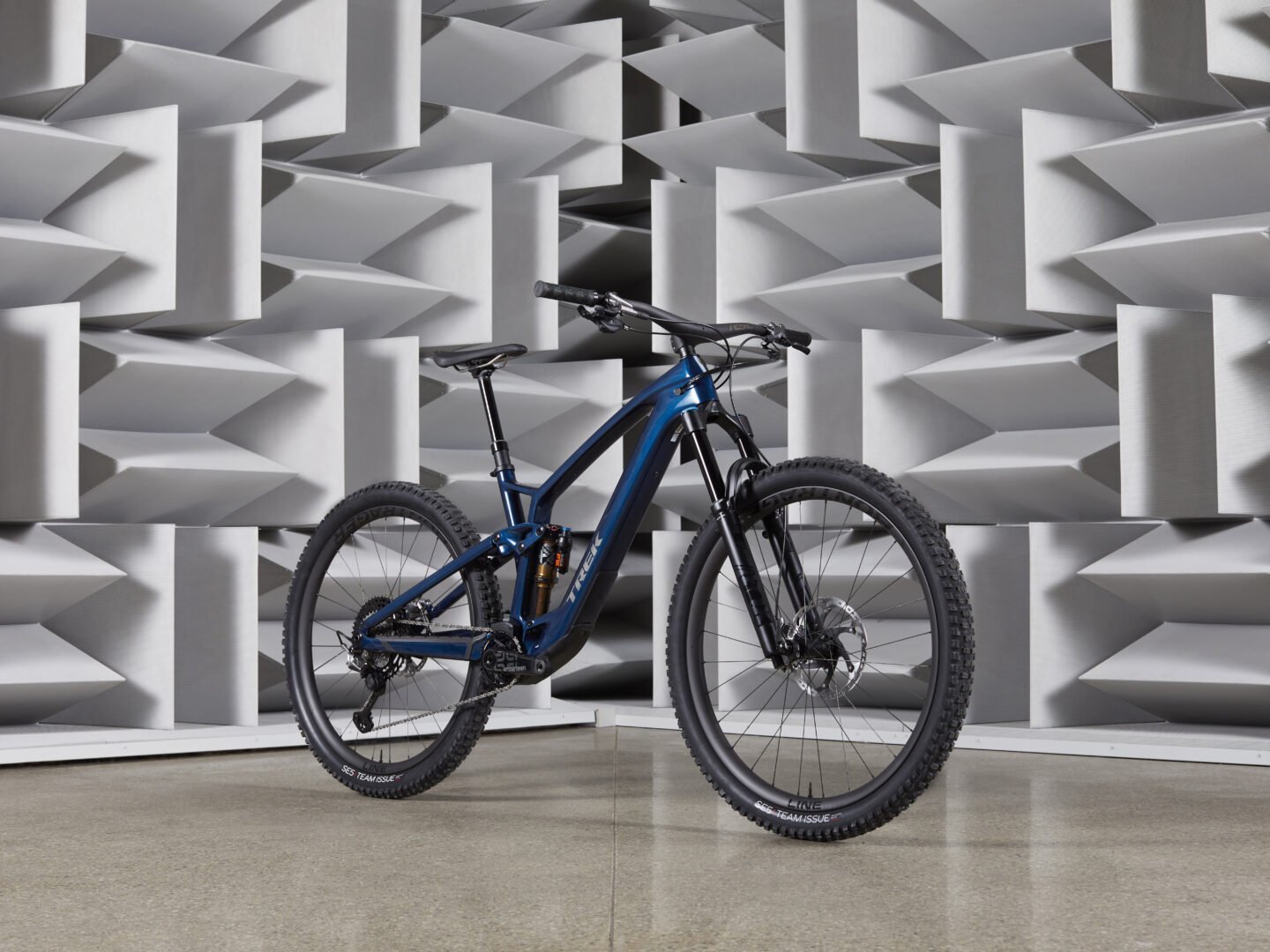
Tipik e-bisiklet motorları, motor gücünü dişliler, miller, kayışlar ve / veya kasnaklar aracılığıyla motordan kranka aktarır. Birbirine kenetlenen çok sayıda hızlı hareket eden parça, yüksek perdeli hoş olmayan gürültü yaratır.
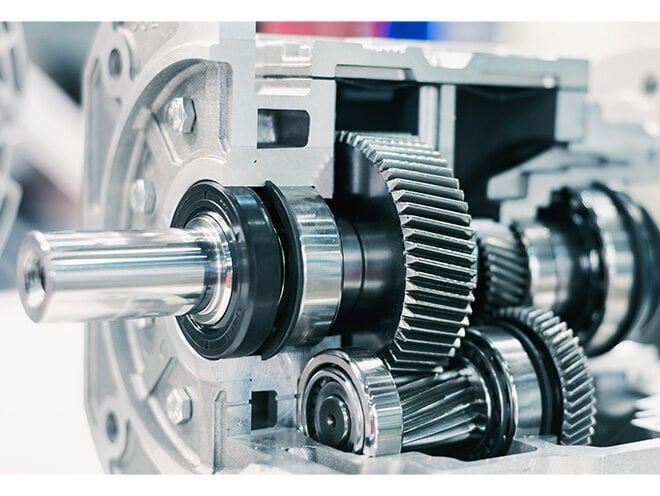
Bilinenin aksine, Fuel exe'nin harmonik pim halkası motoru, yükün her zaman birçok diş arasında sessizce paylaşıldığı tek dişli arayüzüne sahiptir.
Bu yazıda sizi bisiklet akustiğinde bilimsel bir yolculuğa çıkaracağız. Bu, muhtemelen sizin için düşündüğünüzden çok daha önemli olan yepyeni bir bisiklet performansı kategorisidir.
Sonunda, Fuel Exe'nin diğer popüler e-Mtb'lerden 5 kat daha hoş ve 1,8 kat daha sessiz geldiğini göstereceğiz. Aslında, Fuel EXE, geleneksel bir yardımsız bisiklete çok daha yakın geliyor ve sizi sürüşün olması gerektiği gibi geri getiriyor.
Şüphelendin mi? Ayrıntılara girmeden önce, izdeki iki popüler e-mtb'ye kıyasla bazı hızlı Yakıt EXe örneklerini dinleyelim. Sonunda kulakları kolay olan bir e-bisiklet!
Muhteşem Kulakların
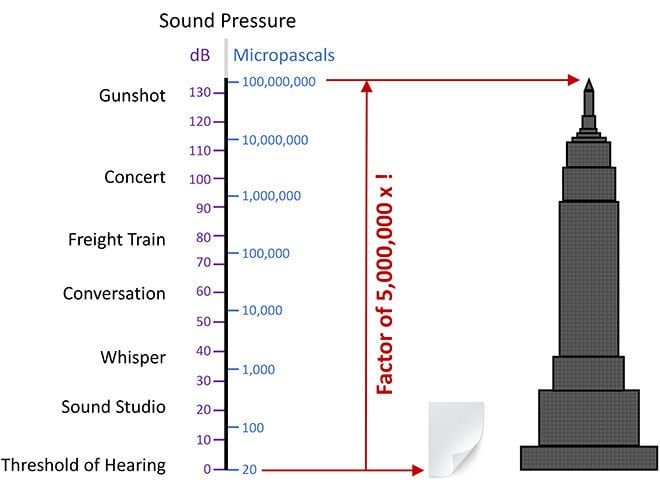
İşitme belki de en güçlü duyunuzdur, ve işitme duyunuza uyması için mikrofon kullanmak oldukça aşırı bilim gerektirir.Kulaklarınız, 20 ila 100.000.000'den fazla mikropaskal arasında değişen ses basıncı genliklerini algılayabilir – kesinlikle büyük bir aralık. Bu, bir kağıdın kalınlığından 100 katlı bir binanın yüksekliğine kadar her şeyi ölçebilen tek bir cetvele sahip olmak gibidir! Bu geniş aralığa uyum sağlamak için tipik olarak logaritmik desibel ölçeğinde (dB) ses hakkında konuşuruz.
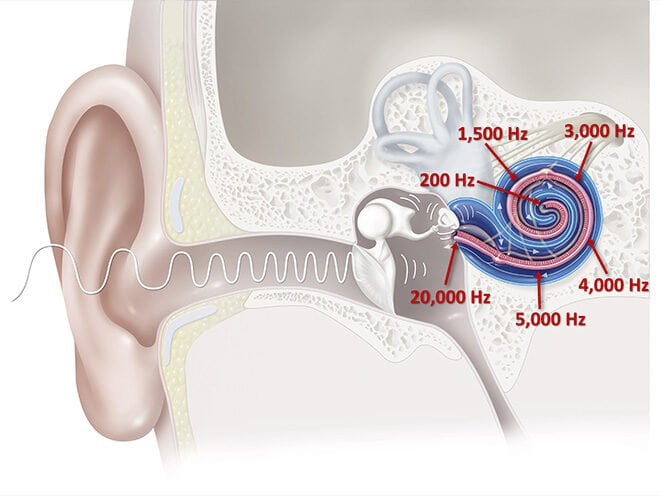
Kulaklarınız ayrıca 20 ila 20.000 Hz arasındaki ses frekanslarını da algılayabilir – başka bir büyük aralık. Kulağınıza ulaşan tek basınç dalgası, etrafınızdaki tüm ses kaynaklarından gelen tüm bu frekansların bir kombinasyonunu içerir. Kulağınızın spiral şeklindeki kokleası, bu birleşik basınç dalgasını tek tek frekanslara ayırır ve bunları sinir sinyalleri olarak kodlar. Kulaklarınız gerçekten güçlü ve büyüleyici ses sensörleridir!
Psychoacoustics
The nerve signals from your ears are then interpreted by the acoustic analysis supercomputer that is your brain. Just imagine the nearly-miraculous processing power and precision required to separate and pinpoint the 3-dimensional location of multiple sound sources in real-time (called sound localization). Your brain further analyzes the patterns of all these sounds and then assigns meanings, emotions, and associations to them.
Psychoacoustics is the study of how your ear-brain system senses and interprets sound. And various psychoacoustic metrics have been developed to convert raw microphone data into how you perceive sounds in terms of both quantity (loudness) and quality.
Perceived loudness
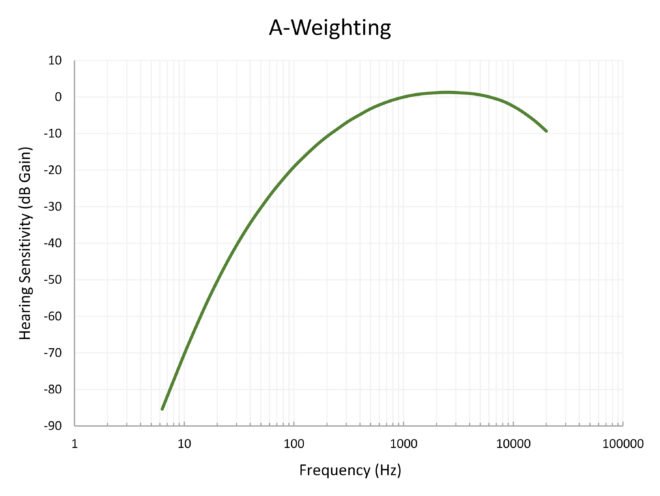
Your hearing sensitivity varies greatly across the frequency range. For example, a 75 dB sound wave at 1,000Hz sounds much louder than a 75dB sound wave at 100 Hz. A common way to account for this varying sensitivity is to apply an A-weighting curve to convert decibels (dB) to A-weighted decibels (dBA). dB defines the physical magnitude of the sound wave, whereas dBA approximates the perceived loudness of that same wave.
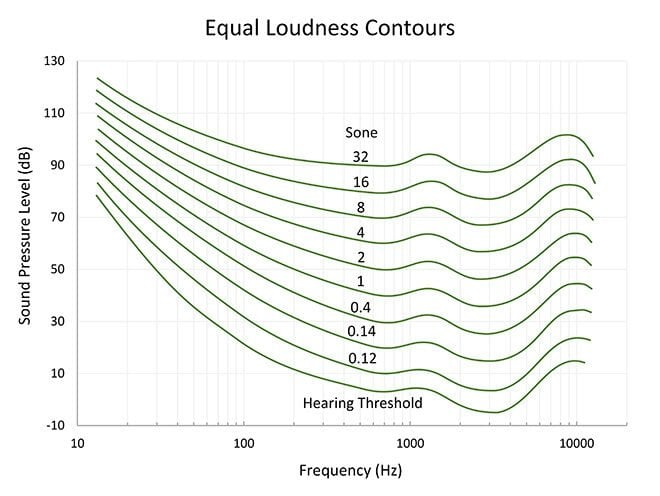
Since the development of the single A-weighting curve, scientists have mapped out a more complete series of "equal loudness contours” that more fully captures the intricacies of your ears. In this graph, any two points along a given line sound equally loud, and each curve is roughly twice as loud as the curve below it. If your ears worked the same as microphones, all of these curves would just be equally spaced horizontal lines.
This chart also introduces the loudness metric sones, which achieves the same purpose as dBA but is more sophisticated and intuitive. Sones scales directly with perceived loudness (2x loudness = 2x sones) whereas dBA is fairly unintuitive (2x loudness = add 10 dB).
Sound quality
Often it is a sound’s quality, rather than its loudness, that dictates your brain’s distinction between good sounds and bad sounds. For example, the high pitch sound of a mosquito is relatively quiet, but it is also quite unpleasant and cuts through the background to grab your attention. Engineers describe this particular type of sound as "tonal,” but our brain can interpret many other sound patterns into categories like rattle, squeal, creak, shrill, rumble, and many more.
Many of these interpretations can be quantified from microphone data using sound quality metrics such as tonality, sharpness, roughness, prominence ratio, fluctuation strength, and articulation index. These metrics can predict your enjoyment using a product, along with your impression of its build quality and performance.
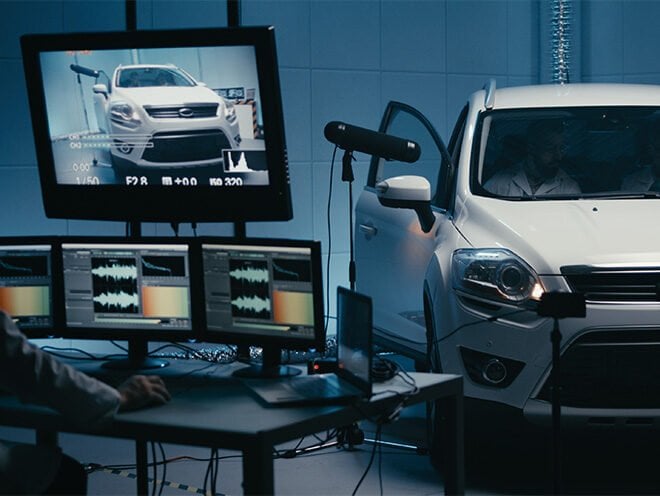
An interesting example in sound quality is the significant engineering effort put into the sound of your car door closing. This sound is secondary to the car’s core function, but it greatly shapes your initial impression of the car’s sturdiness and reliability.
E-Bike psychoacoustics
So how does this all relate to bikes?! Over several years pioneering bicycle psychoacoustics, Trek Performance Research has discovered that your bike’s sound quality – often even more than its loudness – has a big impact on the enjoyment of your ride. For e-MTBs, we have focused on two sound quality metrics – Tonality and Articulation Index.
Tonality
Electric motors tend to make high pitch tones which can be perceived as especially unpleasant [1, 2]. Just like the example of the mosquito, the whine of an e-bike motor cuts through the background to grab your attention.
Tonality (specifically Tonality HMS) is a modern sound quality metric that uses a series of advanced algorithms to accurately model human perception of these kinds of unpleasant tones. We believe tonality is a key new metric for what riders experience on an e-bike.
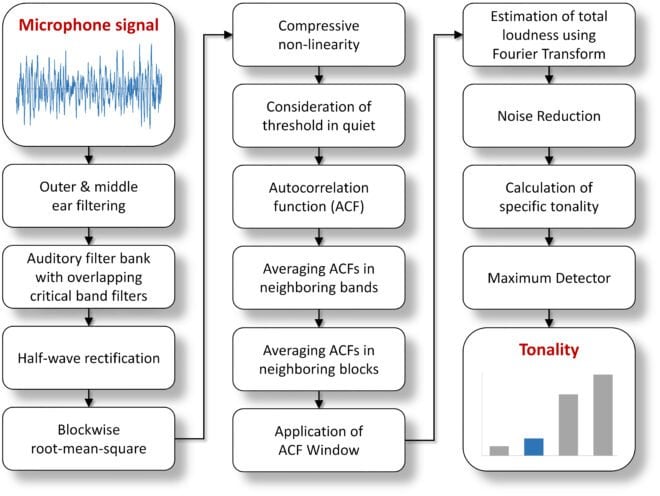 The Tonality HMS calculation uses a complex sequence of 14 algorithms to model your ear-brain
 system's perception of annoying tones (from the ECMA-74:2019 standard)

Articulation index
A big part of riding with friends and family is the ability to chat, teach each other new skills, and guide each other through new trails. But various sounds on the trail – including your e-bike motor – can block your ability to hear what others are saying. Articulation Index is a sound quality metric that predicts the proportion of speech that is audible and is a good indicator of how sounds may detract from the group ride experience.
Tools & knowledge
Psychoacoustics is a challenging new science in cycling, but it makes a big difference to the ride experience. Trek’s development of bicycle psychoacoustic tools & knowledge reflects its commitment to improving the ride experience through science. When added to our well-established vibration capabilities and expertise, Trek Engineering can now measure, understand, and design for everything you feel and hear on the bike.
Fuel EXe psychoacoustics
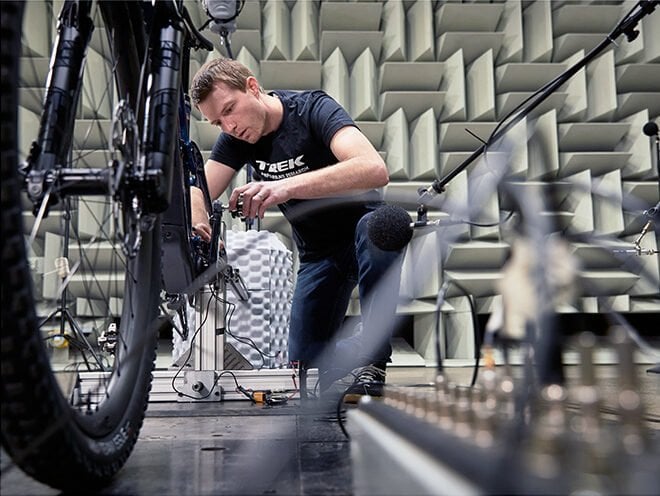
Fuel EXe revolutionizes how quiet and pleasant an e-bike can sound – a fact that we can illustrate using advanced psychoacoustic testing & analysis techniques that were developed throughout the bike’s prototyping phase. The culmination of this testing was a final production bike shootout in the most controlled sound environment possible – an anechoic chamber.
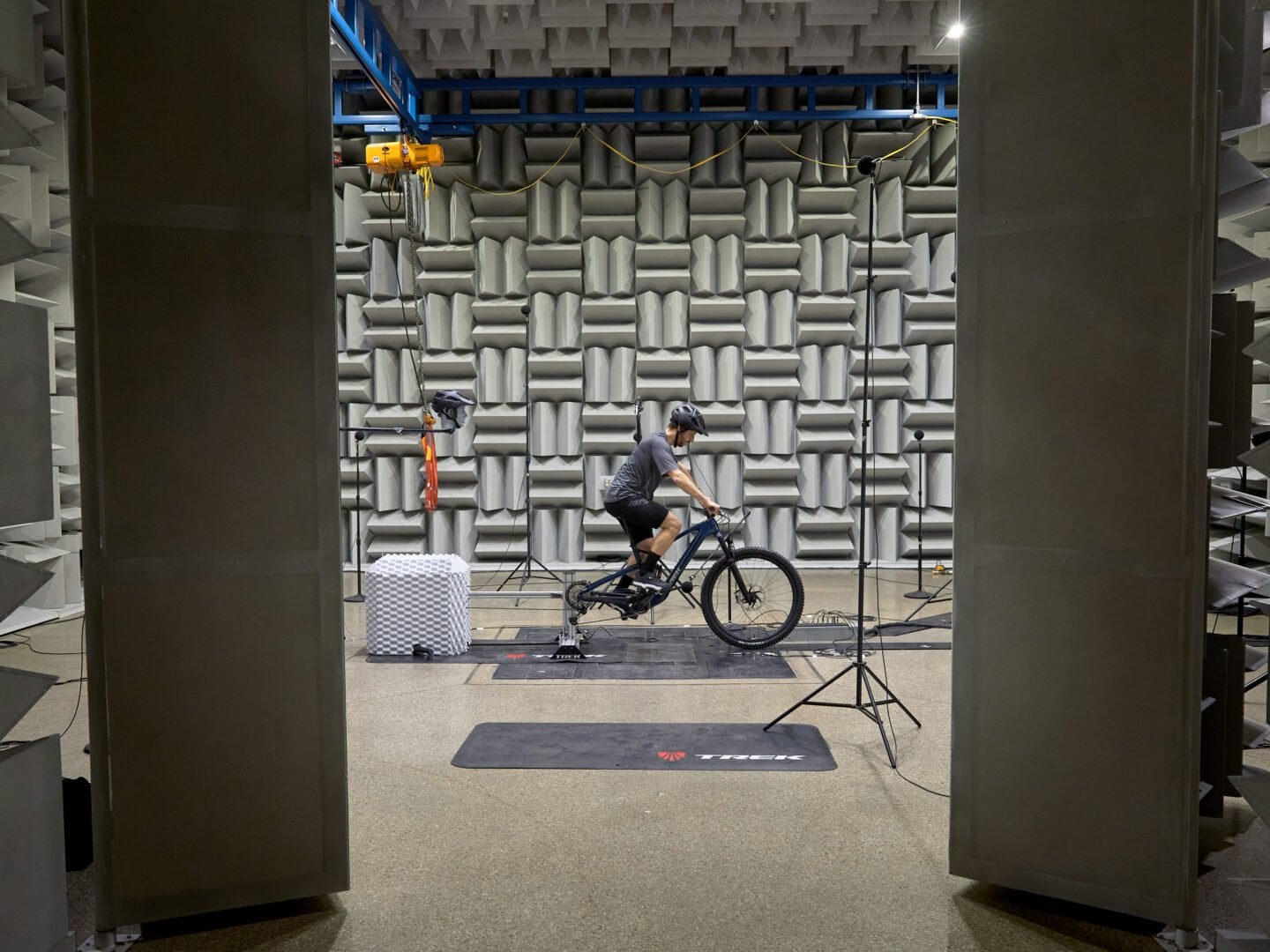
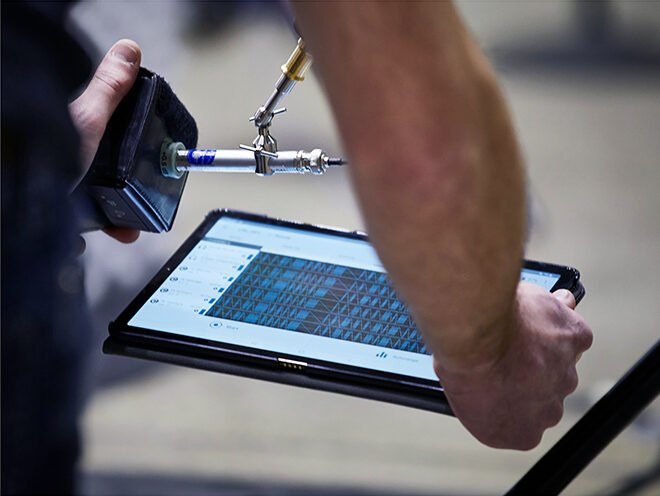
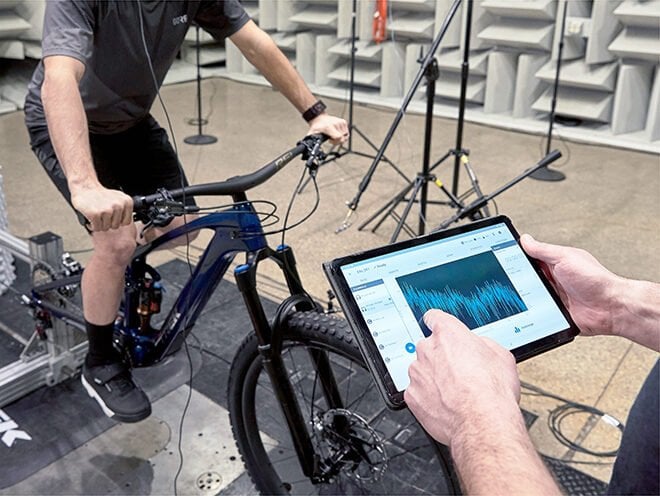
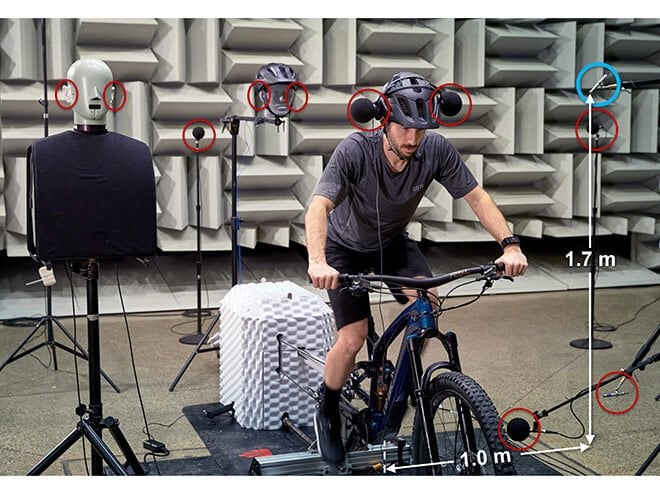
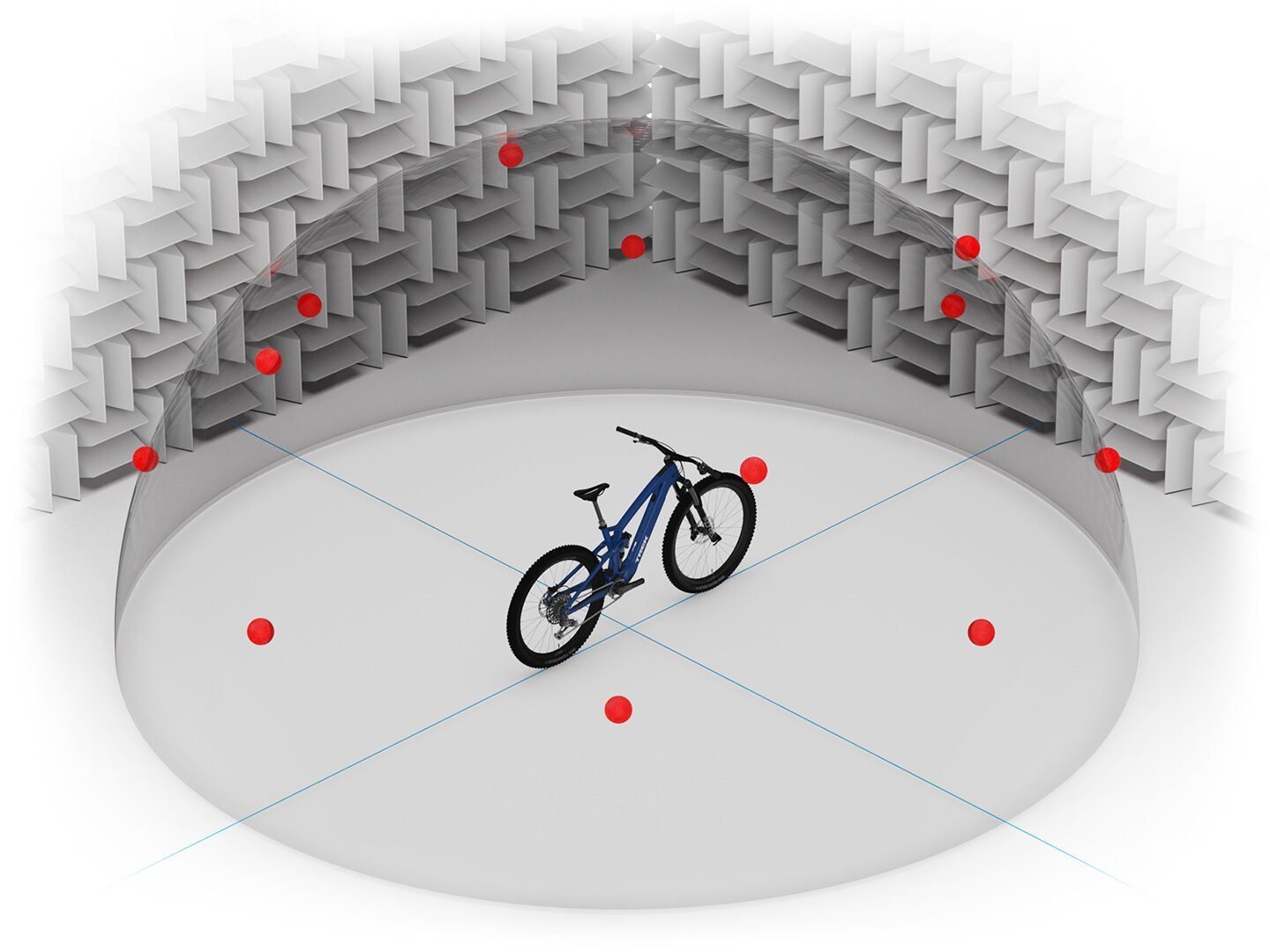
In the anechoic chamber, we compared Fuel EXe to a traditional unassisted bike, a popular light-assist e-MTB, and a popular high-powered e-MTB across a wide range of conditions on a custom sound-isolated trainer fixture. Over the course of two days, we collected 225 million data points using 21 microphones and a cadence sensor that allowed us to relate sound frequency to motor speed.
In these tests, we analyzed the bikes’ tonality, loudness, sound power and articulation index over a cadence range of 40–100 rpm, at total power of 300W, and in the two highest motor assist levels. All charts are based on a B&K 4966-H-041 microphone located 1 m laterally from the bike and 1.7 m vertically from the floor (at head height, circled blue.)
Fuel EXe tonality
Below we see the results for tonality – our key metric for e-bike motor noise perception. The left graph shows tonality over the cadence range, and the right graph averages these results to a single number for each bike.
These tonality graphs show that Fuel EXe is comparable to an unassisted bike and 4-5x more pleasant than other popular e-MTBs. Additionally, Fuel EXe’s tonal noise is barely perceptible, whereas typical e-MTBs are well above the unpleasant threshold.
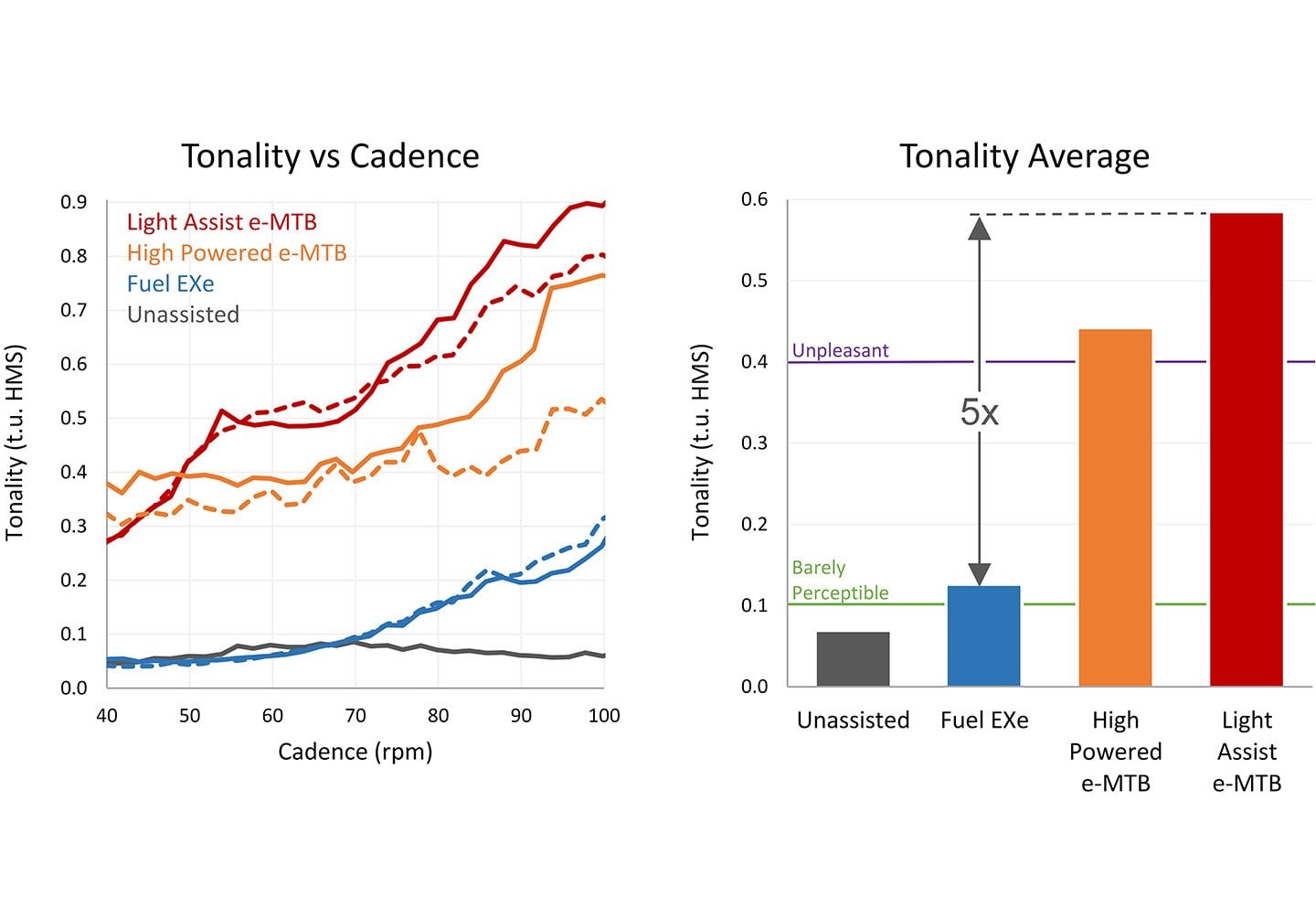
"Fuel EXe sounds 4–5x more pleasant
than other popular e-MTBs”
than other popular e-MTBs”
Sound samples
Not a big fan of graphs? Listen for yourself from inside the anechoic chamber!
Fuel EXe loudness
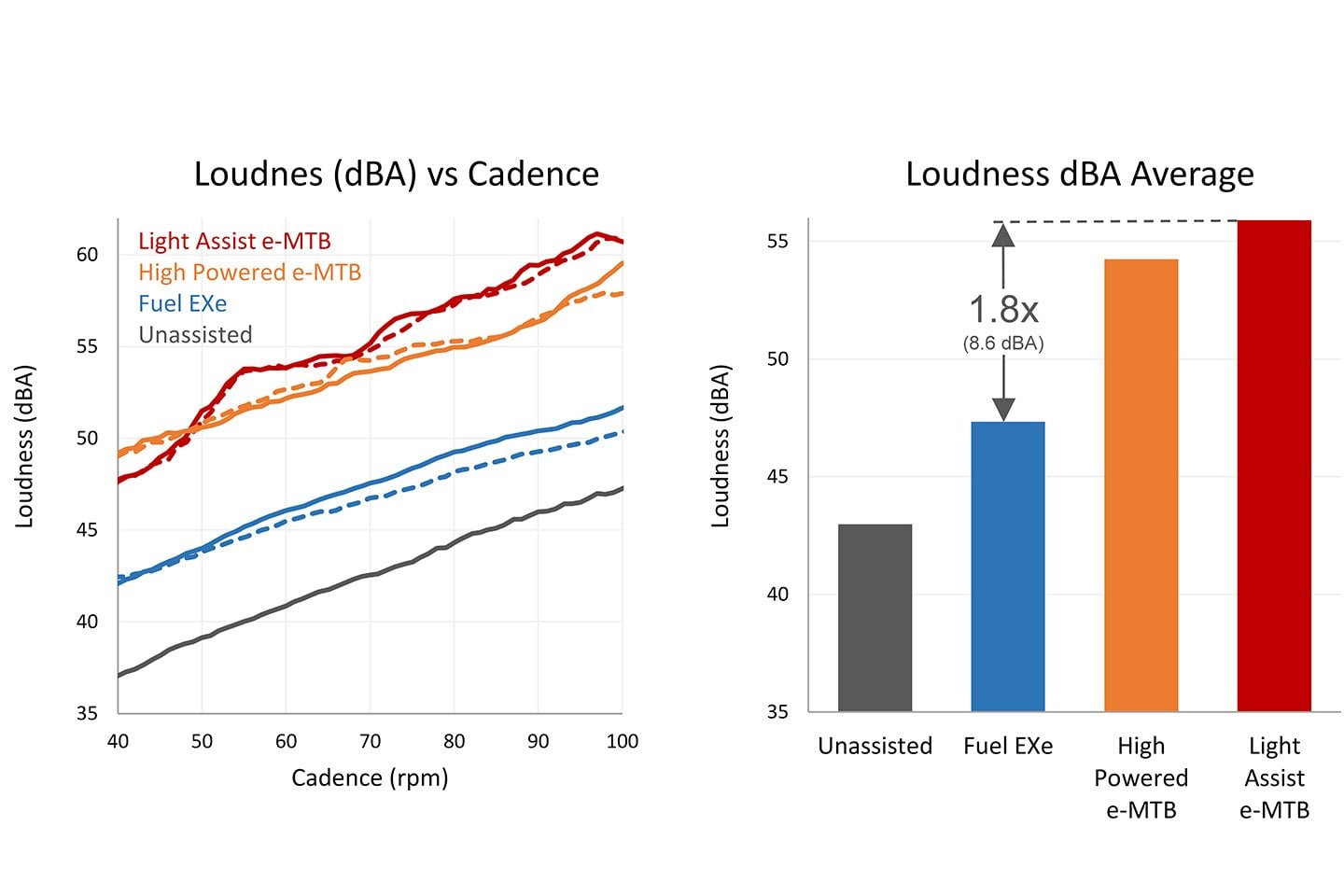
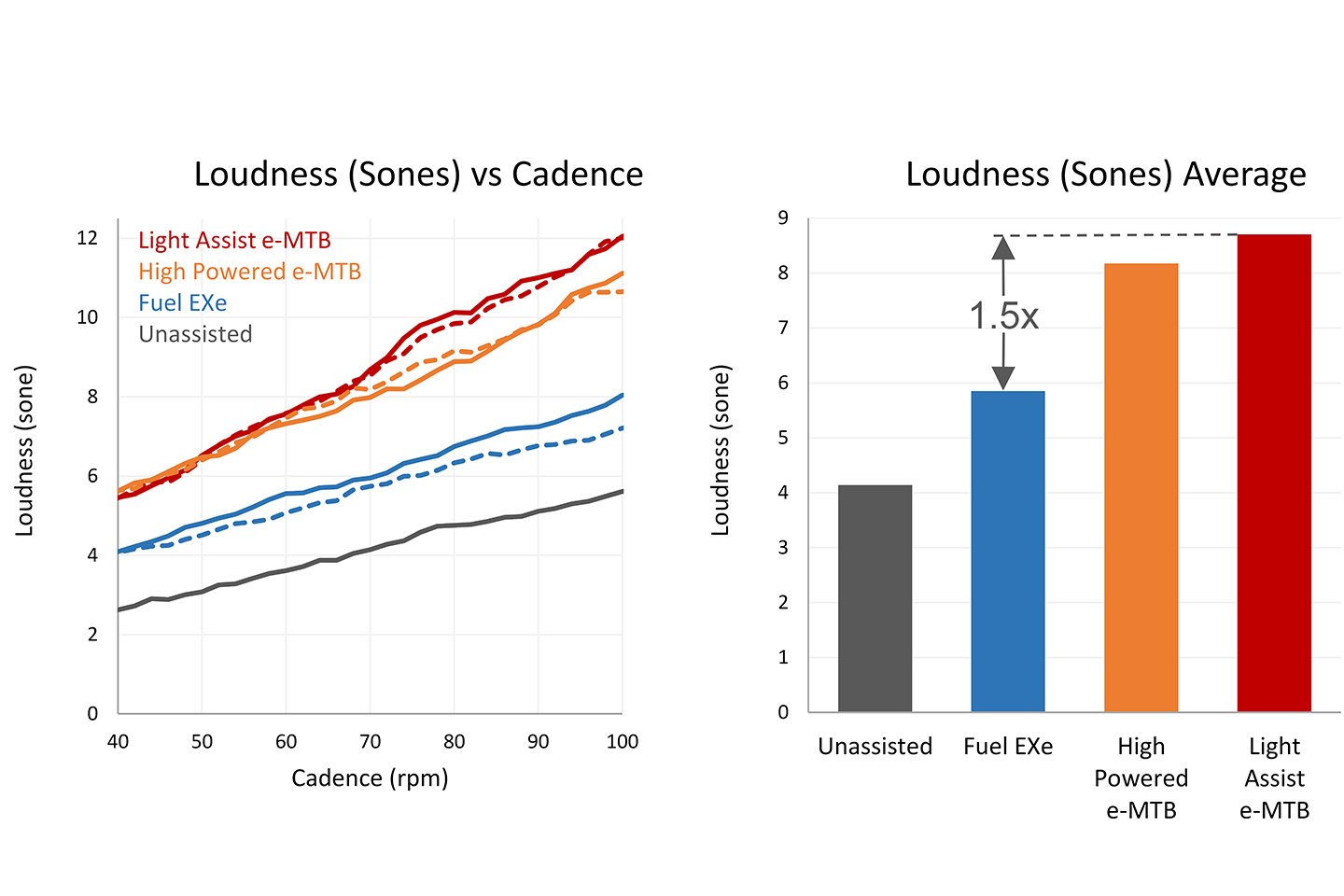
While the tonality best relates to your e-bike ride experience, we didn’t forget about loudness. The graphs below show perceived loudness in both dBA and sones. Depending on which combination of bikes and metrics we consider, the EXE is 1.5–1.8x quieter than the other e-bikes and most comparable to unassisted bikes.
Fuel EXe sound power
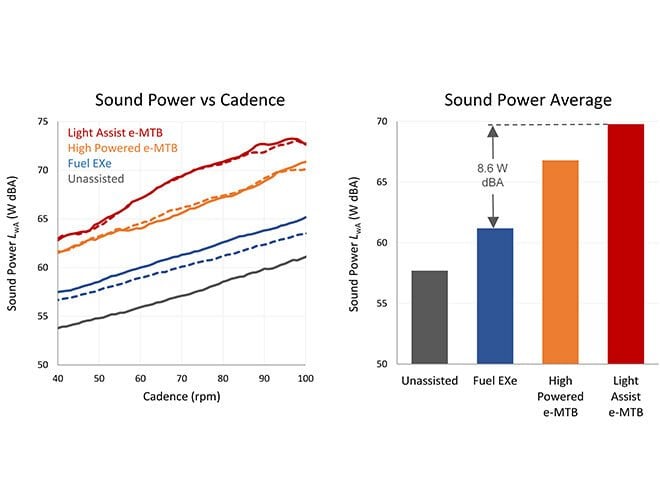
Loudness is a key acoustic metric, but it depends on the microphone’s chosen distance direction from the sound source. Our microphone location was chosen to represent the sound at the rider’s or riding partner’s ears, since that’s the location that matters most.
But we additionally took the next step of measuring sound power, which uses a hemispherical array of 12 microphones to quantify the total sound energy emitted from the bike in all directions. In other words, sound power represents how the bikes compare to listeners at any location around the bike.
As we see in the graph, sound power ranks very similarly to loudness near the rider’s head. This validates both our loudness results and this chosen location for our single-microphone metrics.

Fuel EXe articulation index
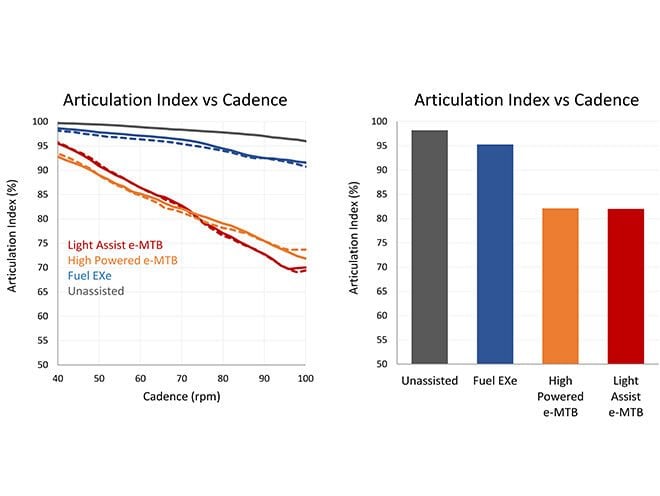
As previously discussed, the sound of your bike can interfere with your ability to talk to others while riding. Articulation Index predicts the amount of speech cues can be heard over a given noise. Again, the EXe is much closer to a traditional bike than to other e-bikes and doesn’t get in the way of your conversations out on the trail.
Field tests
While this article focuses on tests from the highly-controlled anechoic chamber, we also took our acoustic test equipment to the trail for validation. The trail results agreed, with Fuel EXe measuring 3-5x lower in tonality and 1.5-1.8x lower in loudness than the other e-MTBs.
Color map analysis
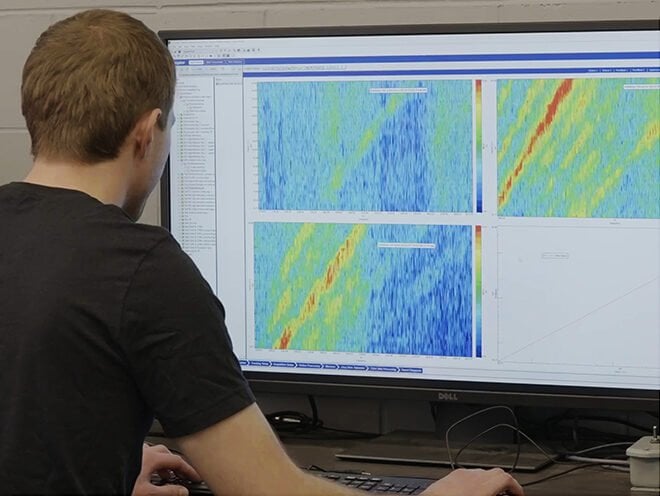
A very powerful analysis technique is to map loudness as colors across a scale of both cadence and sound frequency. In the color maps below, each diagonal line represents a tone whose frequency (pitch) increases with cadence – these are the tones that cut through the background and grab your attention as unpleasant.
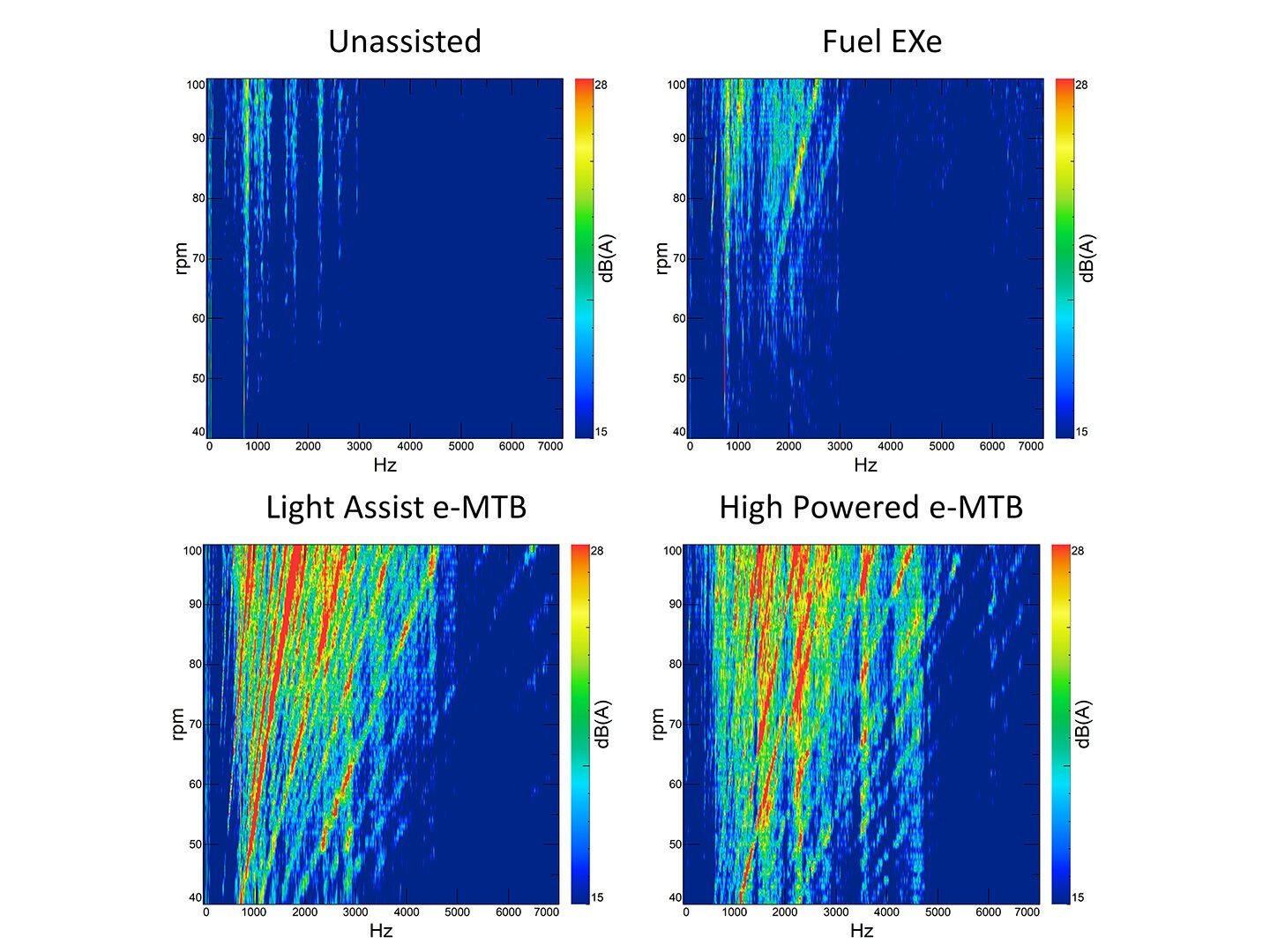
Each of these diagonal lines correspond to a physical spinning component within the motor, whose gear ratio and tooth/magnet count relates to the slope of the line. Clearly, the traditional e-bike transmissions have a lot of moving parts which create a lot of tones, whereas the Fuel EXe’s harmonic pin ring gear creates just a single, much quieter tone.
Still skeptical?
Are you still skeptical that that a 5x reduction in acoustic tonality will bring you total zen on the trails? Click the link below to find out where you can check out Fuel EXe in person!
About the author
Paul Harder is a Principal R&D Engineer at Trek Bicycle. Since earning an MS in Mechanical Engineering from the University of Wisconsin in 2007, he has dedicated his career to making your ride better through science & innovation.
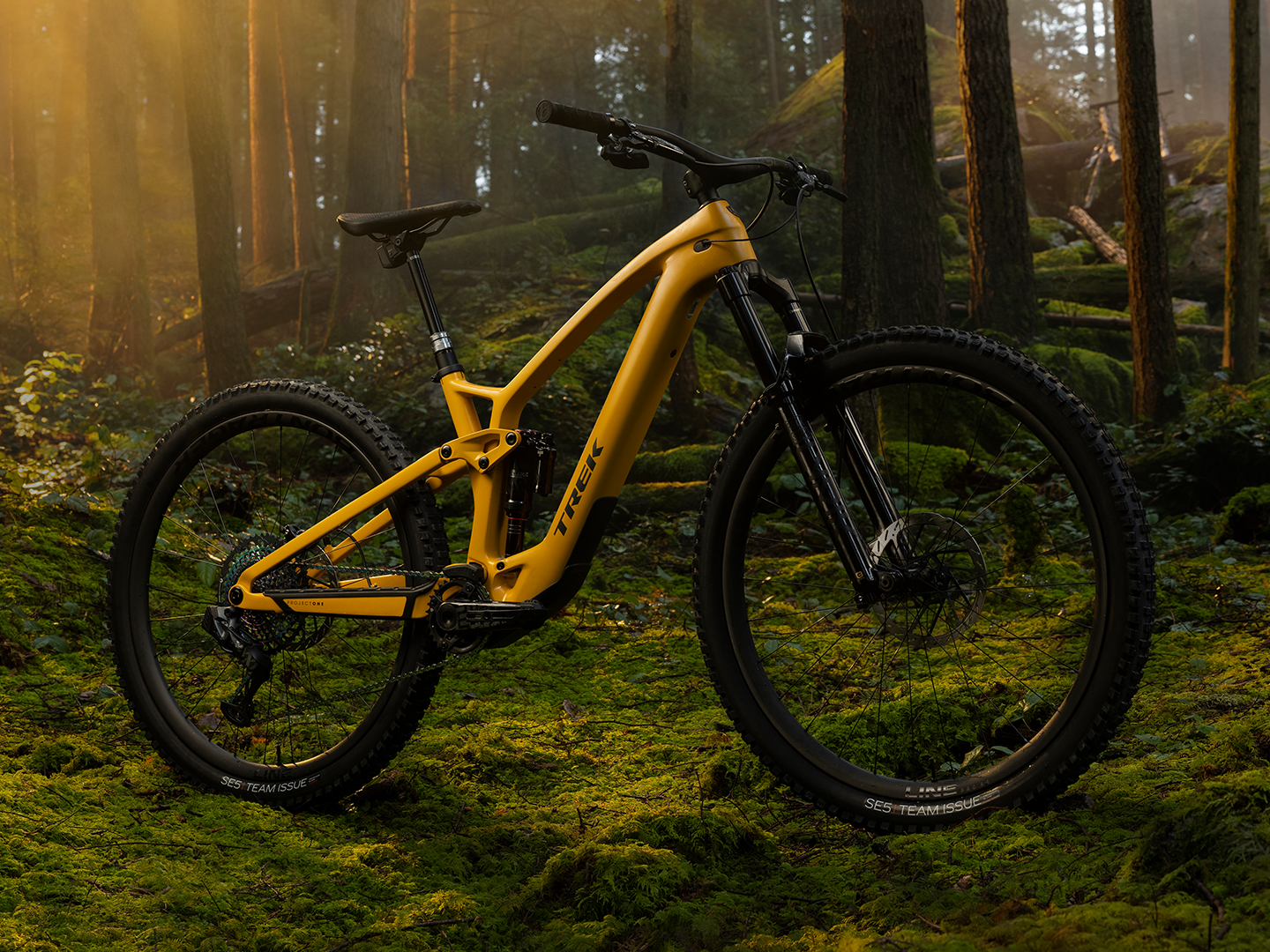
The all-new Fuel EXe
It's the dawn of a new era for mountain biking. The electric Fuel EXe empowers you to do more without interrupting the way you experience nature. Just as a mountain bike should.
EXPLORE